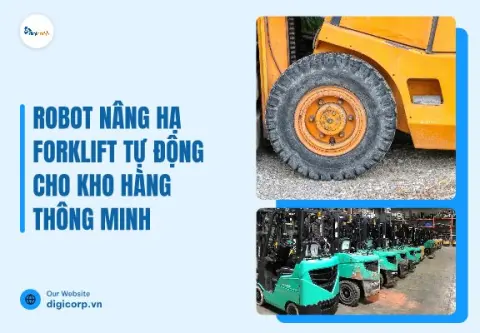



This article helps businesses in Ho Chi Minh understand automatic pallet lifting robots, the common types, practical benefits, implementation process, and considerations before investing.
The automatic pallet lifting robot is a solution that helps businesses in Ho Chi Minh transport, lift, and arrange pallets in warehouses and factories without a direct operator. This equipment is suitable for factories, distribution centers, and warehouses with stable pallet flow, aiming to reduce reliance on manual labor and limit collision risks. The article below explains how the robot works, common types, implementation process, and points businesses should consider before investing.
What is an Automatic Pallet Lifting Robot and Who Is It Suitable For
This is a class of autonomous robots (AGV or AMR) designed with a lifting fork similar to traditional forklifts, capable of self-positioning, self-moving, and autonomously lifting and lowering pallets based on commands from a control system. The robot uses laser sensors, cameras, or positioning markers to determine its location, while also detecting obstacles to slow down or stop when necessary.

In Ho Chi Minh, the demand for warehouse automation is evident in industrial zones, export processing zones, and suburban logistics centers. The entities that typically benefit the most include:
- Manufacturing plants with repetitive pallet flow between production lines and finished goods warehouses.
- E‑commerce and retail distribution centers that need to handle goods continuously across multiple shifts.
- Cold storage and food warehouses where the working environment is harsh for human operators.
- Businesses facing difficulties in recruiting and retaining forklift drivers.
Benefits of Deploying Automatic Pallet Lifting Robots in Warehouses and Factories
The biggest benefit is stability: the robot performs the same task following the same process, ensuring a consistent and predictable transport rhythm. Additionally, businesses gain operational data to optimize the warehouse instead of relying on intuition.
Reducing Occupational Safety Risks
Collisions between forklifts and pedestrians are common hazards in warehouses. The robot is programmed with zone-specific speeds and equipped with anti‑collision sensors, thereby reducing dangerous situations caused by fatigue or loss of focus. Nevertheless, businesses still need to define clear pathways and work zones.
Optimizing Workforce and Operational Time
The robot can operate across multiple shifts and automatically return to a charging station when the battery is low, depending on its configuration. Staff can be reassigned to higher‑value tasks such as quality control, system monitoring, or handling exceptions.
Data Transparency and Easy Integration
The coordination system records task history, distance traveled, and waiting times. When integrated with warehouse management software (WMS) or manufacturing execution systems (MES), transport orders can be generated automatically, reducing manual data entry and errors.
Common Types of Pallet Lifting Robots Today
Each robot type suits a different problem, so selecting the right category is more important than choosing a feature‑rich device. Below are the common groups found in warehouses and factories.

Low‑Level Pallet Lifting Robots
Used to pull and move pallets on the floor between areas, e.g., from the end of a production line to a staging zone. This type is suitable when there is no need to stack pallets onto high racks.
Stacking and High‑Level Lifting Robots
Capable of lifting pallets onto multi‑level racks or stacking pallets. Businesses need to verify rack height, load capacity, and floor flatness before selecting this line.
Counterbalance‑Style Robots
Designed without a front stabilizer leg, able to handle non‑standard pallets or pallets placed close to the ground. This type is flexible but requires a larger turning radius.
Implementation Process for Automatic Pallet Lifting Robots in Ho Chi Minh
An effective project typically starts with an on‑site survey, not merely equipment selection. The reference process includes the following steps:

- Current condition survey: assess floor plan, flooring, pathways, pallet types, load capacity, rack height, and hourly transport volume.
- Define problems and objectives: clarify which transport routes should be automated first and which performance metrics need improvement.
- Solution design: select robot type, quantity, positioning method, charging station locations, and software integration plan.
- Pilot testing: deploy on a single route or small area to validate before scaling up.
- Training and handover: instruct operators on basic troubleshooting and safety rules when working alongside the robot.
- Operation and optimization: monitor data, adjust routes, perform regular maintenance, and scale up when appropriate.
For continuously operating businesses, a phased conversion plan should be devised to avoid production interruptions.
Considerations Before Investing and Situations Not Yet Suitable for Deployment
The robot only delivers value when the environment and processes are sufficiently standardized. Before investing, businesses should review the following points:

- Flooring: cracked, sloped, or uneven floors can affect positioning accuracy and lifting safety.
- Pallets and goods: pallets should be uniform in size; misaligned or over‑hanging loads can cause robot errors.
- Network infrastructure: warehouse Wi‑Fi connectivity must be stable across the entire travel path.
- Overall cost: beyond the equipment, consider integration, training, maintenance, and any facility modifications.
- After‑sales service: prioritize vendors with local technical support teams to shorten issue resolution time.
Some scenarios require careful consideration or are not yet ready for deployment: warehouses with very low or irregular pallet flow; facilities that frequently change layout seasonally; unstandardized inbound/outbound processes; or goods with highly varied shapes. In such cases, businesses should first standardize processes and digitize the warehouse before considering a robot.
DIGICORP Partners with Businesses for Warehouse Automation
DIGICORP Joint Stock Company provides autonomous robots and intelligent automation solutions for businesses, offering comprehensive support from consulting and implementation to operation. The goal is to help customers optimize warehouse efficiency and achieve sustainable growth, rather than merely selling equipment.

DIGICORP’s team serves businesses in Ho Chi Minh, Hanoi, and Bac Ninh, capable of conducting on‑site surveys, recommending suitable robot models, and outlining phased implementation roadmaps. This approach allows businesses to validate effectiveness on a small scale before scaling up, reducing investment risk.
If your business is exploring pallet lifting robots for a warehouse in Ho Chi Minh, please contact DIGICORP via Hotline: 0912345678, Email: contact@digicorp.vn, or visit us at 36, Lane 91, Tran Duy Hung Street, Yen Hoa Ward, Hanoi for detailed consultation.