


This article helps restaurant owners in Ho Chi Minh understand what a buffet service robot can do, when to use it and when not, along with deployment processes and criteria for selecting a robot suitable for their space.
A buffet service robot is a mobile device with a storage tray that can move autonomously between the kitchen, the food station, and the guests' tables to bring additional dishes, collect plates and utensils, or escort guests to their seats. For buffet restaurants in Ho Chi Minh City, which often have a high volume of customers during peak hours, the robot reduces staff travel distance and allows them to focus on customer care. This article explains how the robot operates, what tasks it performs well, when it may not be worth investing, and the practical implementation steps.
What is a buffet service robot and how does it work?
Essentially, it is a mobile robot that maps the restaurant layout and then receives commands to navigate to designated points such as table numbers, hot food stations, or the dishwashing area. It uses sensors to detect obstacles and people, automatically slowing down or stopping as needed.
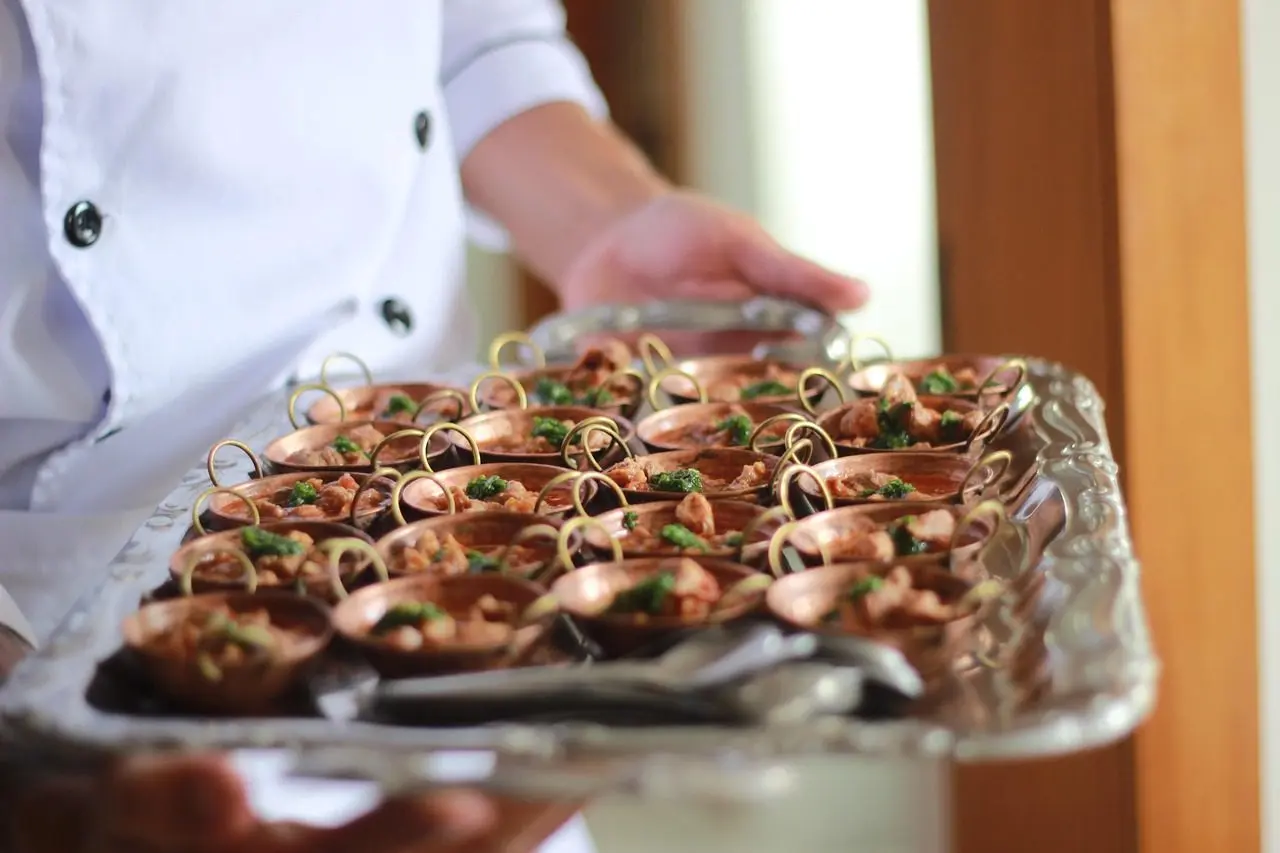
In a buffet model, guests pick food at the station, so the robot’s role differs from that in a dine‑in ordering restaurant. It primarily supports the back‑of‑house: moving dishes from the kitchen to the station, delivering additional orders such as hot pots, grilled items, and beverages to tables, and collecting dirty plates back to the wash area.
Basic Components
- Positioning and sensor system: helps the robot determine its location and avoid collisions.
- Multi‑layer tray: allows carrying multiple dishes or several stacks of plates in one trip.
- Screen and voice: announces arrival at a table and reminds guests to pick up their food.
- Management software: lets staff summon the robot, set destinations, and monitor status.
Benefits of a buffet service robot for restaurants in Ho Chi Minh City
The most obvious benefit is reducing staff workload on repetitive, labor‑intensive tasks such as carrying trays and clearing tables. When the robot handles the movement, staff have more time to replenish dishes, keep stations clean, and address customer requests.

The dining market in Ho Chi Minh City is highly competitive, and many buffet restaurants struggle to recruit and retain service staff. Robots do not fully replace humans, but they help the existing team operate more smoothly during weekends, holidays, or when hosting large groups.
- More consistent service speed: additional orders are delivered continuously, reducing wait times.
- Faster table turnover: dirty plates are collected promptly, facilitating smooth table rotation.
- New experience for guests: especially appealing to families with young children and young groups.
- Modern brand image: creates a highlight when guests share on social media.
The specific effectiveness depends on the space, customer volume, and each restaurant’s workflow, so evaluation should be based on actual operations rather than generic expectations.
What the robot does well and when it may not be suitable
Robots perform best on tasks with clear, repeatable routes that occur many times per shift. Conversely, tasks requiring flexible communication or delicate handling should remain with staff.
Tasks suitable for robots
- Deliver additional orders, drinks, and sauces from the kitchen to tables.
- Move trays from the kitchen for staff to replenish the buffet station.
- Circulate around the dining area to have guests place used plates on the tray.
- Escort guests to pre‑arranged tables during busy periods.
- Greet guests and introduce promotional programs at the lobby.
Cases requiring careful consideration
- Multiple levels and narrow walkways: robots struggle to move without elevators or wide passages.
- Uneven floors or thick carpeting: can affect stability when transporting hot items.
- Very small restaurants: when the distance from kitchen to table is short, the benefit may not justify the cost.
- Heavy or spill‑prone dishes: full hot pots or charcoal grills should be placed by staff for safety reasons.
Deployment Process for a Buffet Robot
Effective deployment starts with a real‑world survey; you shouldn’t buy equipment before figuring out how to use it. A reasonable process typically includes the following steps.
- Space survey: measure corridor widths, kitchen, food station, wash area locations, and identify potential bottlenecks during peak times.
- Define priority tasks: decide what the robot will do first, e.g., only tableware cleaning or only delivering additional orders.
- Select robot models and quantity: based on payload, tray layers, and customer flow.
- Map creation and configuration: number tables, set stop points, define routes, and designate no‑entry zones for the robot.
- Staff training: instruct staff on how to summon the robot, load trays correctly, and handle error notifications.
- Trial runs and adjustments: operate for several shifts to fine‑tune speed, routes, and task allocation.
- Regular maintenance: clean sensors, check batteries, wheels, and update software.
Important to adjust job assignments concurrently. If staff continue to carry trays as before, the robot will be underutilized and fail to deliver value.
Criteria for Selecting a Robot and Implementation Partner
When choosing a robot for a buffet restaurant, prioritize stability in crowded environments and on‑site technical support rather than appearance alone. Below are the criteria to verify.
- Payload and tray layers: suitable for the number of plates and dishes per trip.
- Obstacle avoidance capability: test the robot in the actual restaurant during busy hours.
- Battery life and charging method: should support long shifts and allow staggered charging.
- User‑friendly interface: new staff should be able to operate it after a short period.
- Warranty and support: a nearby technical team to resolve issues quickly.
- Scalability: easy to add robots or integrate with ordering systems when needed.
DIGICORP COMPANY supplies autonomous robots and intelligent automation solutions for businesses, providing in‑depth support from consulting and surveying to deployment and operations. Their customer service teams in Ho Chi Minh City, Hanoi, and Bac Ninh help restaurants select configurations that fit their space and unique workflow.
If your restaurant is considering deploying a robot for a buffet model, contact DIGICORP via Hotline 0912345678 or Email contact@digicorp.vn for consultation and a site survey. Office: 36 Trần Duy Hưng Alley, Yên Hòa Ward, Hanoi City.