

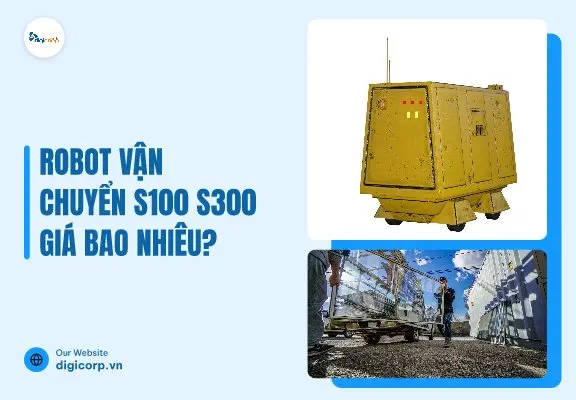
The price of the S100 S300 transport robot depends on configuration, software, integration level and included service package. This article helps businesses understand how to calculate costs and prepare information to receive an accurate quote.
The S100 S300 transport robot does not have a fixed price applicable to all businesses, because the actual cost depends on the robot configuration, coordination software, level of integration with existing systems, and accompanying service package. The fastest way to know the exact figure is to send a request with site layout information, type of goods, and operating process to the supplier. This article helps you understand where the price comes from, what to compare, and what to prepare before requesting a quote.
How Much Does the S100 S300 Transport Robot Cost?
Short answer: the price is quoted per project. Two businesses buying the same robot line can still receive different costs, because one only needs a robot running a fixed route, while the other needs integration with warehouse management, elevators, or automatic doors.
Therefore, the floating numbers on the internet are usually only references and may not include software, installation, training, or maintenance. When comparing, businesses should request a detailed quote by item rather than just looking at the robot's body price.
Factors Determining Robot Price
The investment cost of a transport robot is usually composed of several parts. Understanding each part helps you know which costs are mandatory and which can be considered in stages.
Configuration and Payload
Payload, robot body size, battery capacity, and charging time directly affect the price. Robots for heavy goods or continuous multi-shift operation usually require higher configuration. Compare official specifications of each model with actual cargo weight to avoid over- or under-specification.
Navigational Technology and Sensors
A robot that navigates using laser, camera, or a combination of sensors will have different costs. The more complex the environment, the more people passing through or frequent layout changes, the higher the requirement for obstacle detection and avoidance.
Coordination Software and Integration
If operating multiple robots simultaneously, businesses need fleet management software to route and avoid bottlenecks. Connecting to warehouse, production, or equipment systems such as elevators and sliding doors is a cost item that varies with complexity.
Modules and Accessories
Supports, rollers, lifting mechanisms, additional charging stations, or towing brackets are options that change the total cost. Only select modules that directly serve the process needing automation.
Quantity and Included Services
The number of robots, survey scope, installation, personnel training, and warranty period are all included in the quote. Orders of many robots usually require more detailed route design and coordination.
Distinguishing the S100 and S300 When Choosing
The two models are mainly differentiated by load capacity, size, and application range. Companies should ask “what does the robot need to carry, how much, and over what distance” before deciding which model is suitable.

- Load weight and dimensions: measure the maximum weight per trip and the size of parcels, trays, or carts to be transported.
- Travel space: check aisle width, turns, slopes, door thresholds, and floor conditions.
- Operating frequency: trips per hour, shifts per day determine battery and charging station requirements.
- Scalability: if production is expected to increase, consider the ability to add robots or modules in advance.
The exact specifications of each model should be verified through technical documentation and an on‑site survey. Selecting a model larger than needed raises unnecessary cost, while choosing a smaller model may overload the robot and reduce its lifespan.
Total Cost of Ownership to Consider Upfront
The purchase price is only part of the equation. To assess investment efficiency, companies should calculate the total cost over the robot’s lifecycle.
- Initial investment cost: robot, accessories, software, charging station.
- Implementation cost: surveying, mapping, route configuration, system integration, trial runs.
- Facility modification cost: floor treatment, aisle expansion, additional charging points if needed.
- Operating cost: electricity, periodic maintenance, replacement of wear parts such as batteries and wheels.
- Training cost: instructing staff on operation, handling situations, and safe coordination.
Placing these costs alongside benefits such as reduced manual travel time, fewer errors, and freeing staff for higher‑value tasks will give you a realistic view of the payback period.
Accurate Quotation Process
To provide a quote that matches your needs, the supplier must fully understand your current situation. Preparing the information in advance shortens the exchange time and minimizes future issues.
- Describe the current process: departure point, destination, number of trips, type of goods and weight.
- Provide a floor plan: include images of aisles, doors, elevators if available.
- Specify systems to integrate: warehouse management software, production systems, or other automation equipment.
- On-site survey: engineers assess the floor, propose suitable robot models and quantities.
- Receive a detailed quote: request a clear breakdown of each item, warranty conditions, and support scope.
For large projects, consider piloting on a single route before scaling up, which validates performance and allows appropriate configuration adjustments.
Considerations Before Investing
Transport robots deliver the greatest efficiency when processes are repetitive and movement flows are relatively stable. Conversely, there are cases that require careful consideration or process standardization beforehand.
- Facilities with frequently changing layouts, narrow aisles, or uneven floors.
- Transport volumes too low to justify robot efficiency.
- Goods with irregular shapes that are difficult to secure on the robot.
- Lack of personnel responsible for operation and coordination with the supplier.
Additionally, prioritize a provider that can offer technical support in your region for timely issue resolution, and clarify warranty policies, response times, and spare parts availability.
DIGICORP Joint Stock Company provides autonomous robots and intelligent automation solutions, partnering with businesses from consulting and implementation to operation in Ho Chi Minh City, Hanoi, and Bac Ninh. To receive consultation and a quotation for a transport robot suitable for your facility, please contact Hotline: 0912345678, Email: contact@digicorp.vn or visit us at 36, Lane 91, Tran Duy Hung Street, Yen Hoa Ward, Hanoi.