

This article provides a detailed process for selecting and deploying autonomous robots (AGV or AMR), from defining goals and evaluating criteria to implementation, error avoidance, and maintenance. Read now to optimize productivity and reduce costs for your business.
Consulting for Deploying Autonomous Robots and Tips for Selecting a Vendor
This article provides a detailed process for selecting and deploying autonomous robots (AGV or AMR), from defining goals and evaluating criteria to implementation, error avoidance, and maintenance. Read now to optimize productivity and reduce costs for your business.
1. Consulting for Deploying Autonomous Robots: Which is More Suitable, AGV or AMR?
1.1. Operational Characteristics of AGV
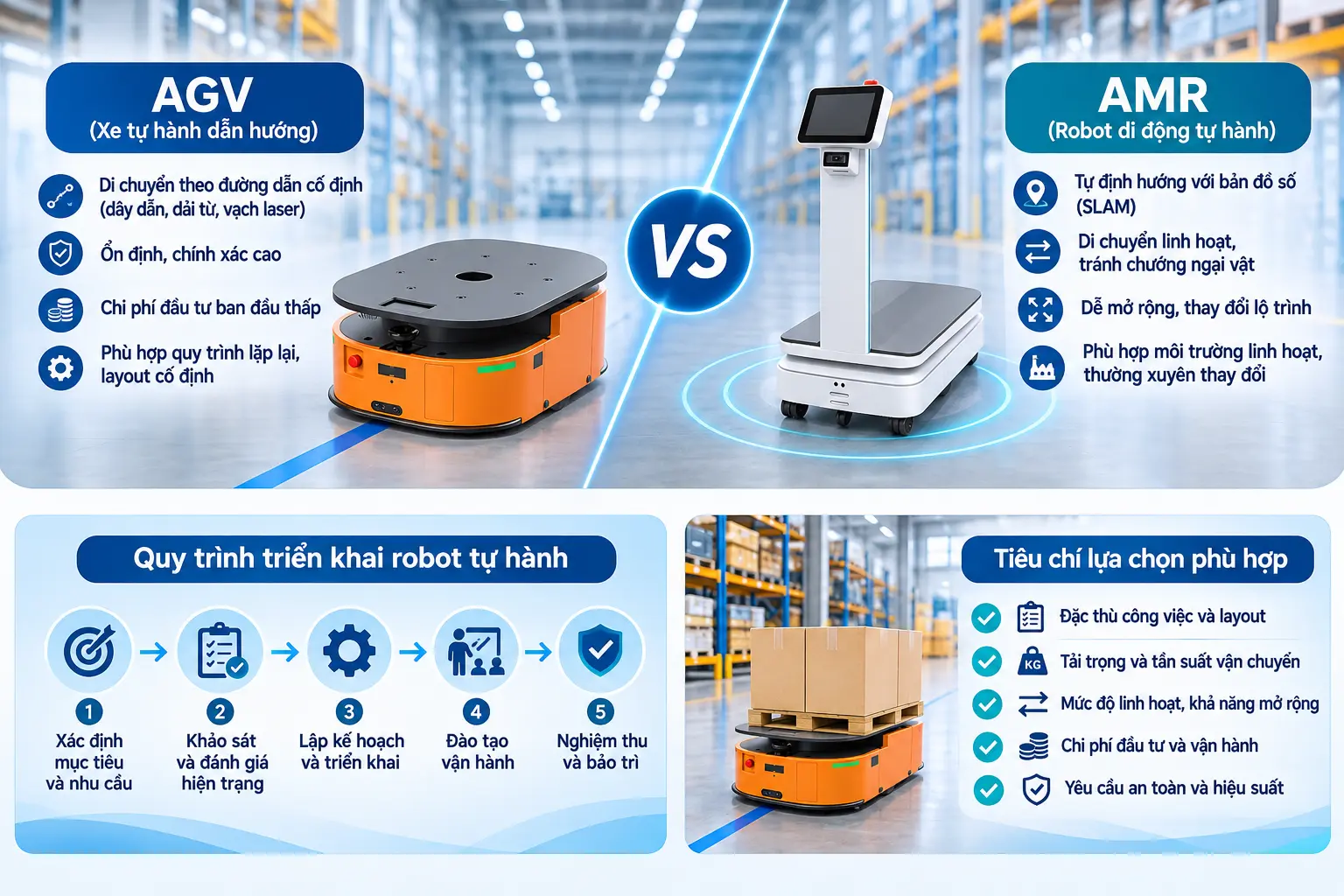
AGV (Automated Guided Vehicle) moves along fixed guides such as wires, magnetic strips, or laser markers. This system requires a pre‑installed “track” in the environment and is usually programmed to perform repetitive tasks like transporting raw materials on a production line. Because it operates on a fixed path, the AGV offers high stability and minimizes collision risk when the environment is tightly controlled.
1.2. Operational Characteristics of AMR
AMR (Autonomous Mobile Robot) uses positioning technology and digital maps (SLAM) to navigate freely in open spaces. The robot can adjust its route based on real‑time situations such as unexpected obstacles or changing transport needs. Thanks to its “self‑thinking” capability, AMR is suitable for factories with flexible, frequently changing layouts or without fixed guidance infrastructure.
1.3. Comparing Real‑World Needs and Benefits
Enterprises should consider three main factors: layout complexity, process change frequency, and financial investment level. If the plant has a fixed layout, stable material flow, and seeks cost‑optimal investment, AGV is usually the reasonable choice because its initial infrastructure cost is lower. Conversely, when the production environment changes often, requires many stopping points, or needs rapid expansion, AMR offers greater benefits due to its flexibility and scalability without infrastructure changes.
2. Goals & Input Requirements
2.1. Determine Scale and Types of Tasks
Before deciding, a company should list the tasks to be automated: raw material transport, finished‑goods delivery, scrap collection, etc. It should also define daily volume, average travel distance, and desired delivery time. For example, an electronics production line that needs to move 2,000 component packages per day with a delivery time under 5 minutes will require a robot with appropriate speed and load capacity.
2.2. Space and Infrastructure Requirements
Assess aisle width, slope, lighting level, and the presence of large industrial equipment. AGVs need enough space to accommodate guide wires or magnetic strips, while AMRs can operate on narrower aisles thanks to obstacle‑avoidance capabilities. If the factory has high ceilings and requires multi‑level movement, the installation of elevators or lifting systems for the robots must also be considered.
2.3. Safety Standards and Performance
Always comply with international safety standards such as ISO 3691‑4 (mobile robot safety) and local worker‑protection regulations. Key safety features include human‑detection sensors, emergency brakes, and speed limits. Additionally, define performance metrics: cycle time, error rate, energy consumption, etc. These metrics will serve as the basis for measuring actual benefits after deployment.
3. Checklist for Evaluating AGV and AMR Selection
3.1. Technical Criteria
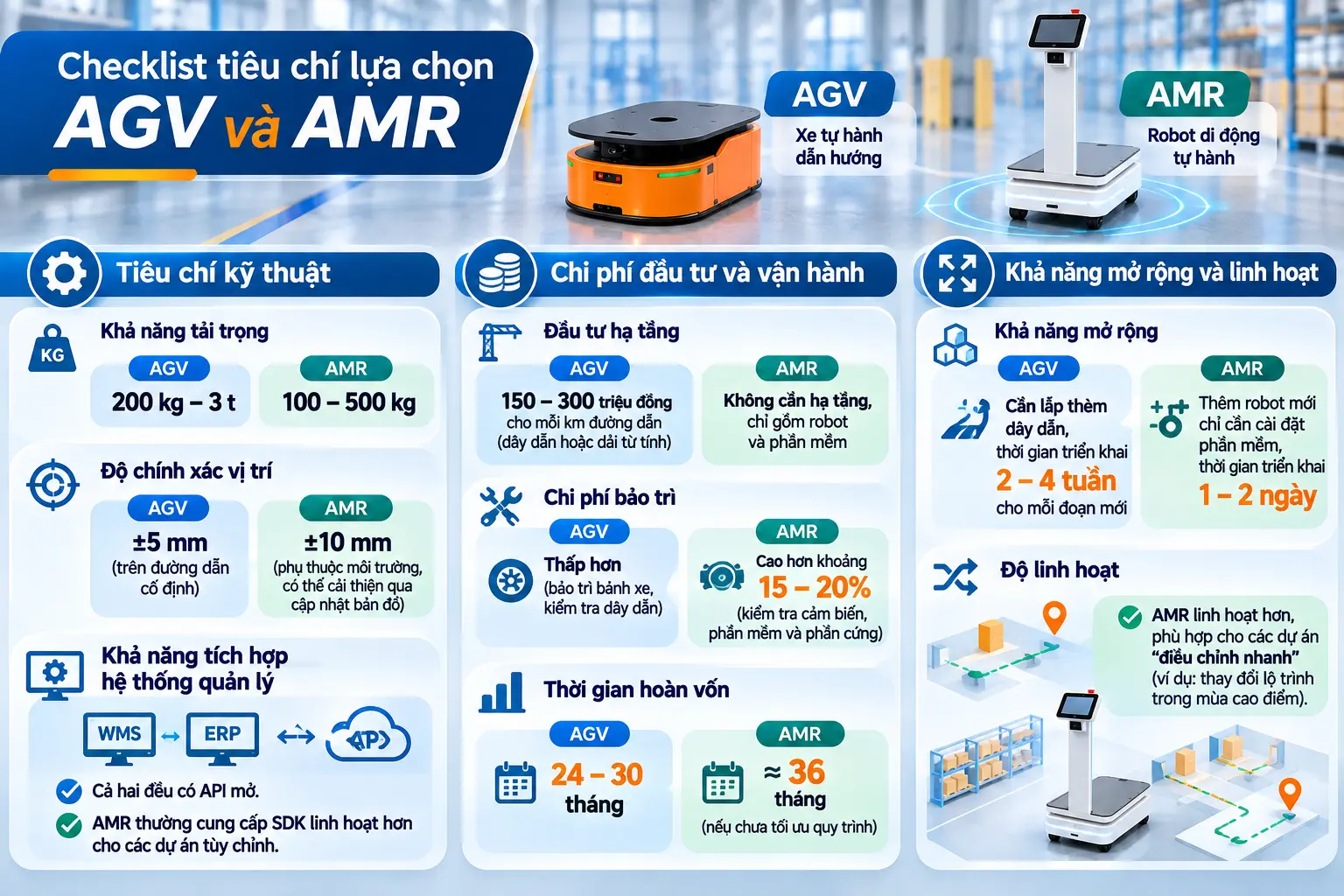
Load capacity: AGVs typically handle loads from 200 kg to 3 t, while AMRs are usually limited to 100 kg – 500 kg.
Positioning accuracy: AGVs achieve a deviation of ±5 mm on fixed paths; AMRs depend on the environment, typically ±10 mm but improve with map updates.
Management system integration (WMS, ERP): Both types have open APIs, but AMRs usually offer more flexible SDKs for custom projects.
3.2. Investment and Operating Costs
Infrastructure investment: AGVs require installation of guide wires or magnetic strips, costing on average VND 150‑300 million per km of path. AMRs need no infrastructure; costs include only the robot and software.
Maintenance cost: AGVs have few moving parts; maintenance usually involves wheel replacement and guide‑wire inspection. AMRs have many sensors, requiring periodic software and hardware checks, with maintenance costs about 15‑20 % higher.
Payback period: For medium‑scale projects, AGVs typically pay back in 24‑30 months; AMRs can extend to 36 months if processes are not optimized.
3.3. Scalability and Flexibility
AGV: Scaling requires adding guide wires, with deployment time extending 2‑4 weeks per new segment.
AMR: Adding a new robot only needs software setup, with deployment in 1‑2 days.
Flexibility: AMRs are suitable for “quick‑adjust” projects, e.g., changing routes during peak seasons.
4. Implementation Process
4.1. Detailed Planning
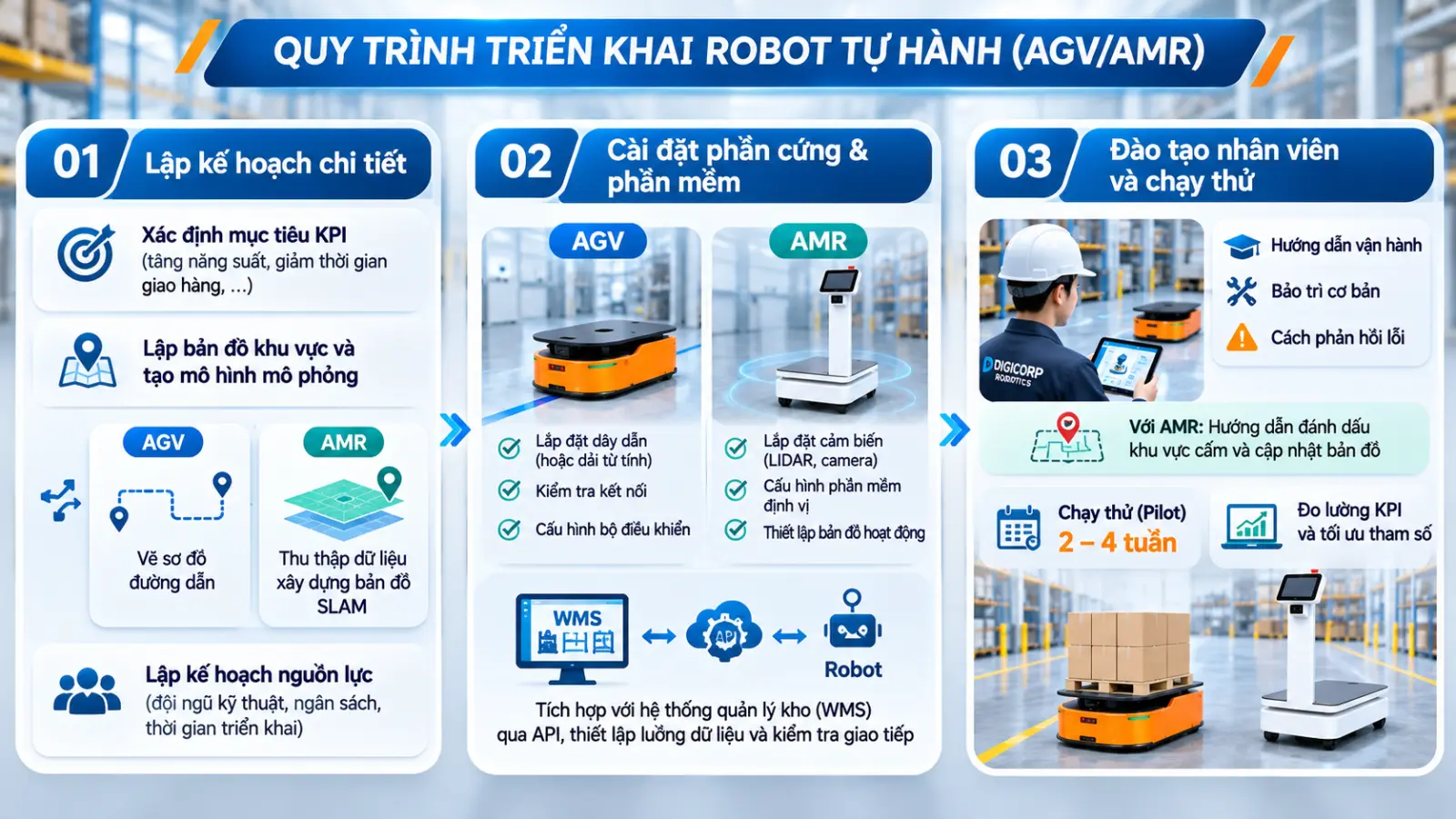
This stage includes defining KPI goals (increase productivity, reduce delivery time), mapping the actual area, and creating simulation models. For AGVs, a guide‑path diagram is required; for AMRs, environmental data must be collected to build a SLAM map. The plan should also list resources: technical team, budget, and deployment timeline.
4.2. Hardware & Software Installation
For AGVs, installing guide wires, checking connections, and configuring the controller are critical steps. For AMRs, mounting LIDAR sensors, cameras, and configuring positioning software are central. After hardware installation, integrate with the warehouse management system (WMS) via API, set up data flows, and verify communication.
4.3. Staff Training and Pilot Run
Training covers operation instructions, basic maintenance procedures, and error‑reporting methods. AMR operators need to learn how to designate restricted zones and update maps. The pilot phase typically lasts 2‑4 weeks, during which the predefined KPIs are measured and robot parameters are tuned for optimal performance.
5. Common Mistakes to Avoid
5.1. Skipping Real‑World Environment Assessment
Sometimes companies rely only on engineering drawings without on‑site verification, leading to AGVs that cannot be installed correctly or AMRs encountering many unforeseen obstacles. The solution is to conduct a detailed survey, recording ceiling height, slopes, and fixed equipment.
5.2. Lack of Regular Maintenance Planning
Not establishing a maintenance schedule reduces robot lifespan and causes production interruptions. For AGVs, guide‑wire and wheel inspections should be performed monthly; for AMRs, sensor and software checks should be carried out quarterly.
5.3. Not Synchronizing Management Systems
Deploying robots without linking them to WMS/ERP results in inconsistent data and inventory discrepancies. Ensure API integration and conduct data validation tests before full‑scale operation.
6. System Acceptance & Maintenance
6.1. Acceptance Criteria
Each robot must meet the following: travel speed ≥ 90 % of design speed, positioning accuracy ≤ 10 mm (AMR) or ≤ 5 mm (AGV), command response time ≤ 2 seconds. Additionally, safety tests must confirm emergency brakes activate within 0.5 seconds.
6.2. Preventive Maintenance Plan
Set up regular maintenance schedules and keep spare parts for critical components (wheels, LIDAR sensors, power units). For AMRs, maintain a software backup and perform monthly firmware updates. For AGVs, keep spare guide‑wire sections for quick replacement when needed.
6.3. Post‑Implementation Performance Evaluation
After 3‑6 months of operation, compare actual KPIs with targets: delivery time, error rate, energy cost. If performance falls short, analyze root causes (robot configuration, layout) and implement optimizations.
7. About Digicorp Robotics – Trusted Partner
Comprehensive Consulting and Implementation Services
Digicorp Robotics offers solutions from on‑site surveys, system design, hardware installation, software integration to staff training. The expert team has over 10 years of experience in industrial automation and has successfully completed more than 200 robot projects in Vietnam.
Demo Support and Warranty
Customers can request an on‑site demo to experience the solution before committing. Digicorp guarantees a 24‑month warranty for all equipment and provides periodic maintenance with a response time of within 48 hours for any issue.
Contact Us Now for the Right Solution
Digicorp Robotics | Giải Pháp Robot Tự Động Hóa Thông Minh
(+84) 901 725 399
contact@digicorp.vn
Representative Office: 36/91 Tran Duy Hung Street, Yen Hoa, Hanoi, Vietnam
Hanoi Office: Viwaseen Tower, 48 To Huu Street, Dai Mo, Hanoi, Vietnam
Ho Chi Minh City Office: 105A Truong Thi Hoa Street, Tan Thoi Hiep, Ho Chi Minh City, Vietnam
Bac Ninh Office: BT17, Dau Ma Street, Vu Ninh, Bac Ninh, Vietnam
https://digicorp.vn