

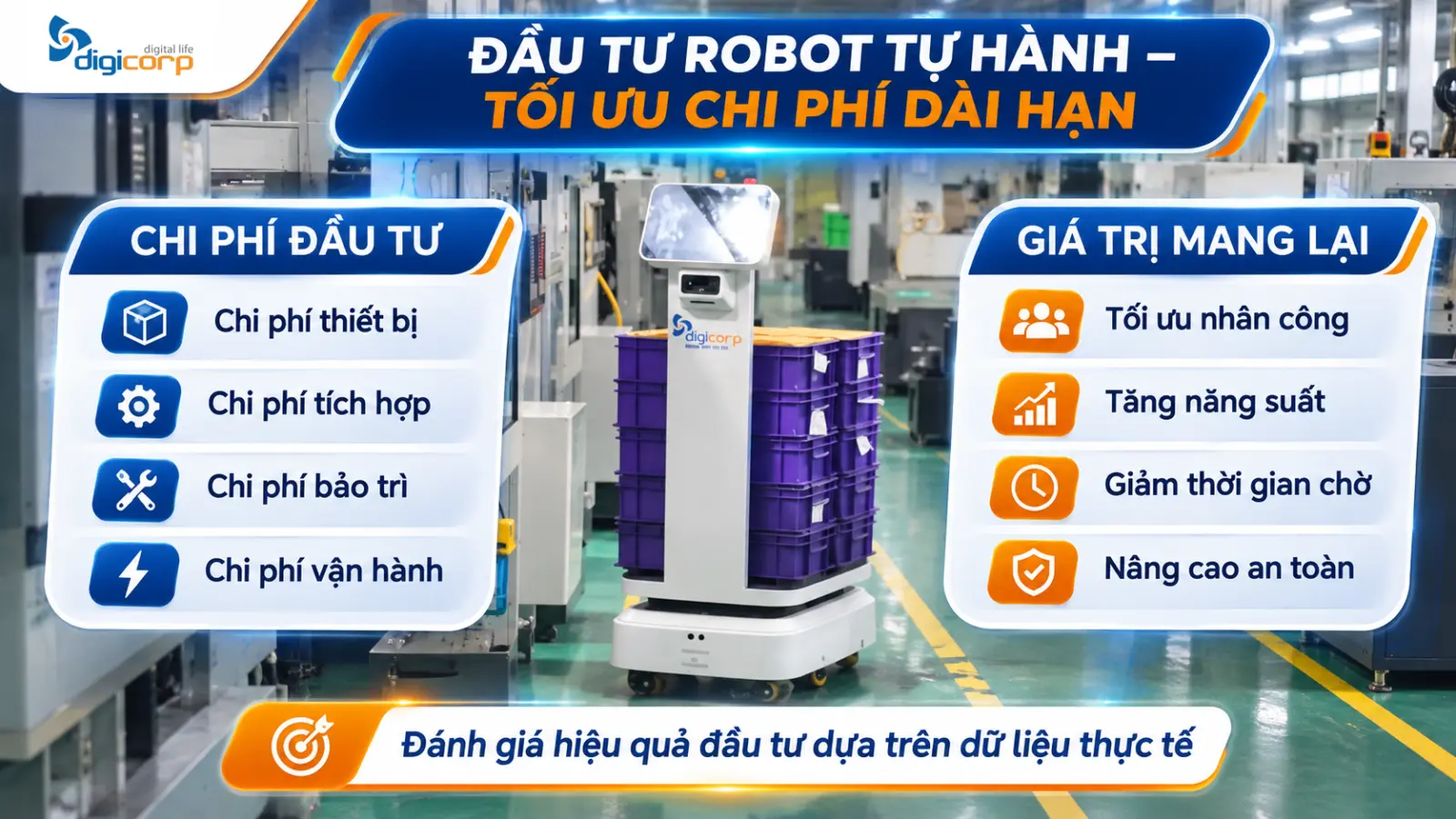
This article provides a quick answer on the price of autonomous robots for factories, analyzes the cost‑determining factors and how to calculate ROI so businesses can optimize their investment. It also guides you in choosing between AGV and AMR, outlines steps to evaluate efficiency, and contact Digicorp for a detailed quotation.
How Much Do Autonomous Robots for Factories Cost?
Autonomous Robots for Factories Cost? This article provides a quick answer on the price of autonomous robots for factories, analyzes the cost‑determining factors and how to calculate ROI so businesses can optimize their investment. It also guides you in choosing between AGV and AMR, outlines steps to evaluate efficiency, and contact Digicorp for a detailed quotation.
1. How much do autonomous robots for factories cost?
1.1. Current reference price range
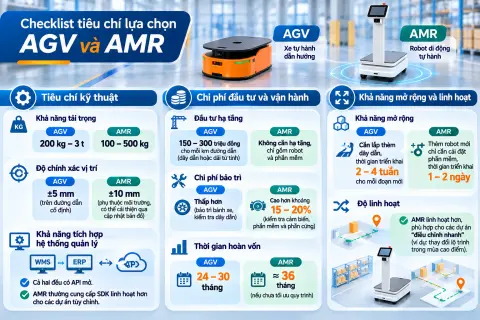
The price of autonomous robots for factories typically ranges from a few million VND for simple models to tens of millions of VND for advanced technology integrations. A basic AGV (Automated Guided Vehicle) with a payload of 1–2 tons usually starts from 3–5 million VND. In contrast, an AMR (Autonomous Mobile Robot) with flexible navigation and automatic obstacle avoidance can reach 10–15 million VND depending on payload and size.
1.2. Purchase price vs. total implementation cost
To get a comprehensive view, businesses need to split costs into two parts: equipment purchase price and actual implementation cost. The initial investment includes the robot price, spare parts, and warranty. The second part covers control software, system integration, site survey, installation, staff training, and periodic maintenance. Typically, implementation costs can account for 30% to 50% of the total investment.
2. Common types of autonomous robots in factories and reference prices
2.1. AGV robots: features and price range
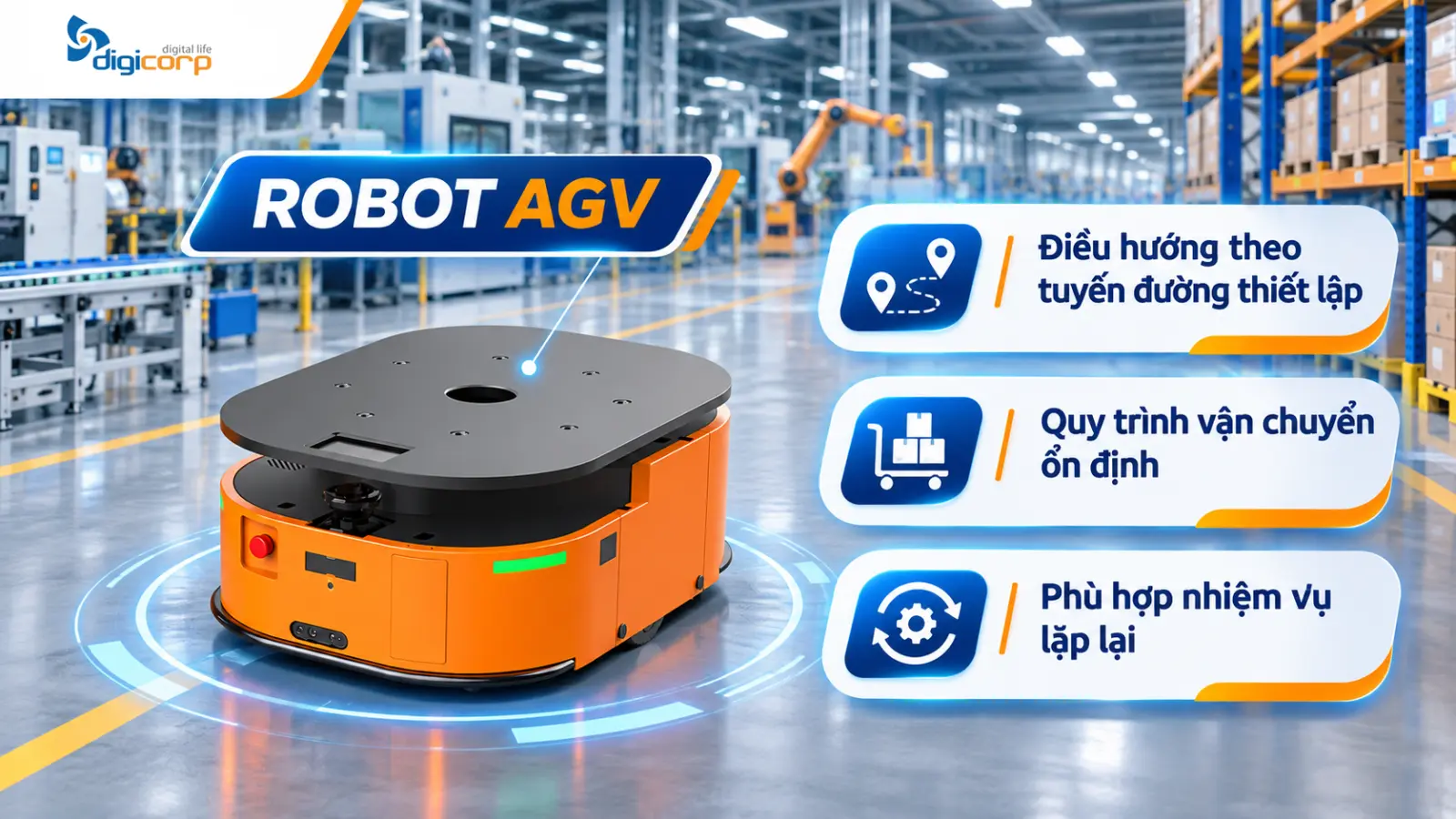
AGVs rely on fixed guidance technologies such as line markings, optical sensors, or RFID. They can carry high payloads, maintain stable speeds, and are suitable for production lines with fixed routes. Reference price: 3–8 million VND depending on payload and guidance system. This solution is ideal when route changes are infrequent.
2.2. AMR robots: features and price range
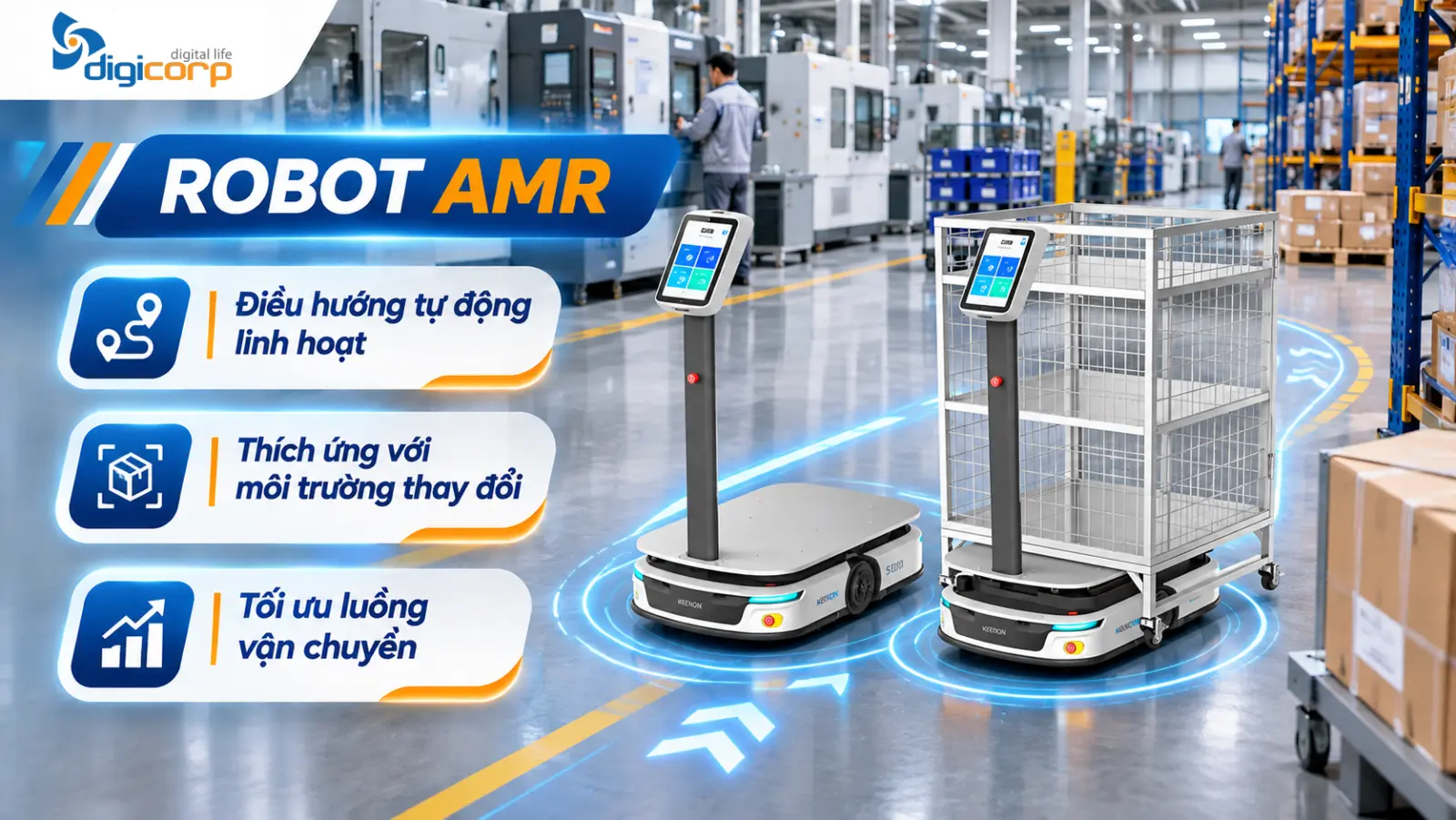
AMRs use indoor positioning technologies (LiDAR, SLAM) to automatically build maps and navigate. They offer high flexibility, allowing real‑time route changes, making them suitable for environments with frequent layout modifications. Price range: 8–15 million VND, plus additional costs for positioning software and sensors.
3. Factors influencing the price of autonomous robots for factories
3.1. Payload, speed and operating time
Robots with larger payloads and higher speeds usually require more powerful motors and more complex controllers, leading to higher prices. Continuous operation (24/7) also demands automatic charging systems or stable power supplies, adding extra cost.
3.2. Positioning technology, obstacle avoidance and automatic charging
Optical or RFID‑based positioning is cheaper than LiDAR or SLAM solutions. Integrating obstacle‑avoidance sensors (ultrasonic, lidar) also raises costs, but improves safety and performance.
3.3. Level of integration with production lines
The robot must communicate with the factory’s SCADA, ERP or PLC systems. Software and hardware integration often requires custom development costs. If the industrial system is already standardized, integration costs will be lower.
4. What does the investment and operating cost of autonomous robots include?
4.1. Software, system integration and site survey
Control software, 3D mapping, and consulting/survey services can account for 10–20% of the total cost. For AMRs, map development and route programming costs are usually higher.
4.2. Installation, maintenance and operation training
Installation requires specialized labor and may involve production line downtime. Periodic maintenance (inspections, part replacements) is typically billed under a service contract. Training operators and maintenance staff is also an unavoidable expense.
4.3. Energy and insurance costs
Robots run on electricity or lithium‑ion batteries; electricity costs are usually low but charging infrastructure must be considered. Insurance for accidents or equipment damage should also be budgeted.
5. Should businesses choose AGV or AMR to optimize costs?
5.1. When to choose AGV
For production lines with fixed routes, large and stable payloads, AGVs are the more cost‑effective option. Implementation costs are lower because advanced positioning technology is not required.
5.2. When to choose AMR
If the work environment changes frequently and requires flexible routing and varying payloads, AMRs provide long‑term benefits. Although the initial investment is higher, they reduce future maintenance and re‑routing costs.
5.3. Comparison of infrastructure requirements and flexibility
AGV: requires fixed guidance infrastructure (line markings, RFID) but offers limited route flexibility.
AMR: no fixed infrastructure needed, highly flexible but depends on positioning technology.
6. How to evaluate investment efficiency and payback period when deploying autonomous robots
6.1. ROI analysis based on transport frequency and labor cost
ROI = (Labor cost savings + Productivity increase) ÷ (Investment cost + Operating cost). Companies should collect daily transport data, waiting times, and labor wages to calculate.
6.2. Tools and methods for calculating payback period
The simplest method is to compute the number of days required for the investment to be recovered from cost savings. If the investment is 10 million VND and savings are 1 million VND per month, the payback period is 10 months.
7. Consultation and quotation for autonomous robot solutions at Digicorp Robotics
Consultation, site survey and solution proposal process
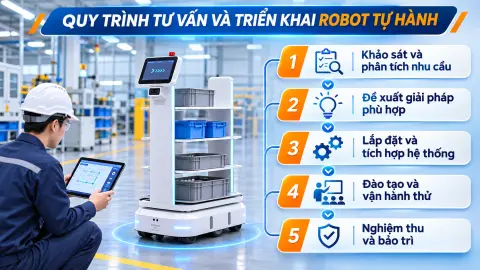
Digicorp Robotics conducts on‑site surveys, analyzes transport needs, assesses infrastructure, and proposes suitable AGV or AMR solutions. After agreeing on the solution, we provide a detailed quotation covering equipment, software, installation and maintenance.
Contact to receive a detailed quotation and register for a demo
For in‑depth consulting and a customized quote, you can reach Digicorp Robotics through the channels below:
Digicorp Robotics | Giải Pháp Robot Tự Động Hóa Thông Minh
(+84) 901 725 399
contact@digicorp.vn
Representative Office: 36/91 Tran Duy Hung Street, Yen Hoa, Hanoi, Vietnam
Hanoi Office: Viwaseen Tower, 48 To Huu Street, Dai Mo, Hanoi, Vietnam
Ho Chi Minh City Office: 105A Truong Thi Hoa Street, Tan Thoi Hiep, Ho Chi Minh City, Vietnam
Bac Ninh Office: BT17, Dau Ma Street, Vu Ninh, Bac Ninh, Vietnam
https://digicorp.vn
For enterprises interested in industrial autonomous robot solutions, we are ready to provide autonomous robots for factories that match your scale and transport needs. Additionally, our autonomous robots for industrial factories are designed to boost productivity and reduce operating costs. For internal logistics applications, we also support automated goods transport robots in factories with flexible and safe control features.